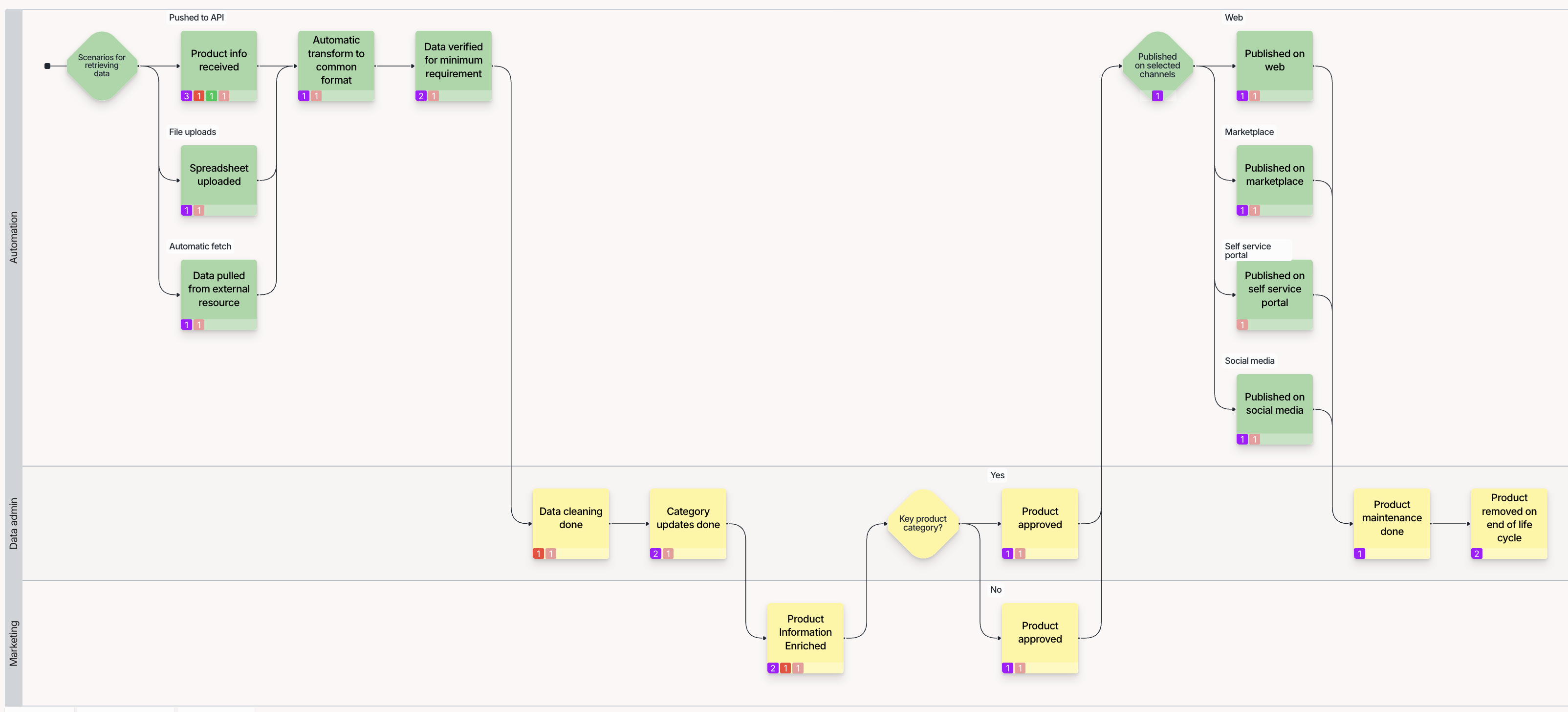
In a recent project, we facilitated several Event Storming workshops for a successful e-commerce company to improve its Product Information Management (PIM) process. The client manages nearly a million SKUs and frequently updates them from a diverse group of suppliers. Our goals were to:
Before new products can be published in the online store, product information must be captured, enriched, and reviewed in multiple process steps such as:
To reduce time to market, we looked for opportunities to increase automation. It was crucial to engage the teams responsible for each step. Some of the key roles included:
Event Storming is an ideal method for tackling complex business processes involving multiple teams and steps. It brings domain experts and engineers together to build shared understanding and align on improvements.
We planned a series of Event Storming workshops with around 10 participants from various departments. Using Qlerify, we started with a blank canvas prepared with standard Event Storming notation: card types for Problems/Hot Spots, Opportunities, and Systems, plus swimlanes for roles.
As we've experienced many times before, Event Storming quickly engaged the participants. The discussions were productive and focused as we collaboratively mapped out all events, roles, and challenges in real-time.
After just two hours, we had outlined the main flow and started digging into sub-flows. By the third hour, we had already reached consensus on the most important problems to prioritize.
Previously, reaching this level of clarity could have taken weeks—if it happened at all. Thanks to Event Storming and Qlerify, we achieved it in just a few working days, saving possibly more than 80% of the time.
An added bonus: communication between departments improved significantly. Before using Event Storming, people often talked past each other, each with their own mental model of the process. Event Storming helped create a shared understanding and alignment around priorities.
Want to learn more about Event Storming or Qlerify?