Build serious software faster—with structure, not just speed
Introduction
AI has changed how software gets built. But moving fast without a clear structure often leads to brittle systems, unclear intent, and results that are hard to reproduce. The most effective engineers aren’t just using AI to generate code—they’re using two disciplined approaches: Specification-Driven Development (SDD) and Model-Driven Development (MDD).
SDD defines what the system should do and why.
MDD defines how the system behaves through executable models.
Together, they give teams a complete, structured foundation that AI agents can depend on. Specifications express intent. Models express structure and behavior. The combination brings precision, predictability, and automation into AI-assisted development.
Why SDD + MDD Matters
Many teams experiment with LLM-generated code, but without specifications and models, the output is inconsistent and hard to scale. “Prompt-driven coding” creates technical debt, unpredictable architectures, and unclear reasoning behind system behavior.
SDD + MDD replaces randomness with intent and structure:
- SDD captures goals, rules, events, constraints, and user journeys.
- MDD translates this intent into diagrams, domain models, and other executable or semi-executable assets.
- AI agents generate code that aligns with both the specification and the models.
This approach gives innovators the ability to build complex systems quickly—while ensuring the architecture remains coherent and traceable.
For teams exploring new ways of building software with AI, this combination removes the guesswork and makes the whole lifecycle more repeatable.
How the Combined Approach Works
- Specify (SDD) – Define desired outcomes, events, rules, value, and user journeys. No code yet—just clear intent.
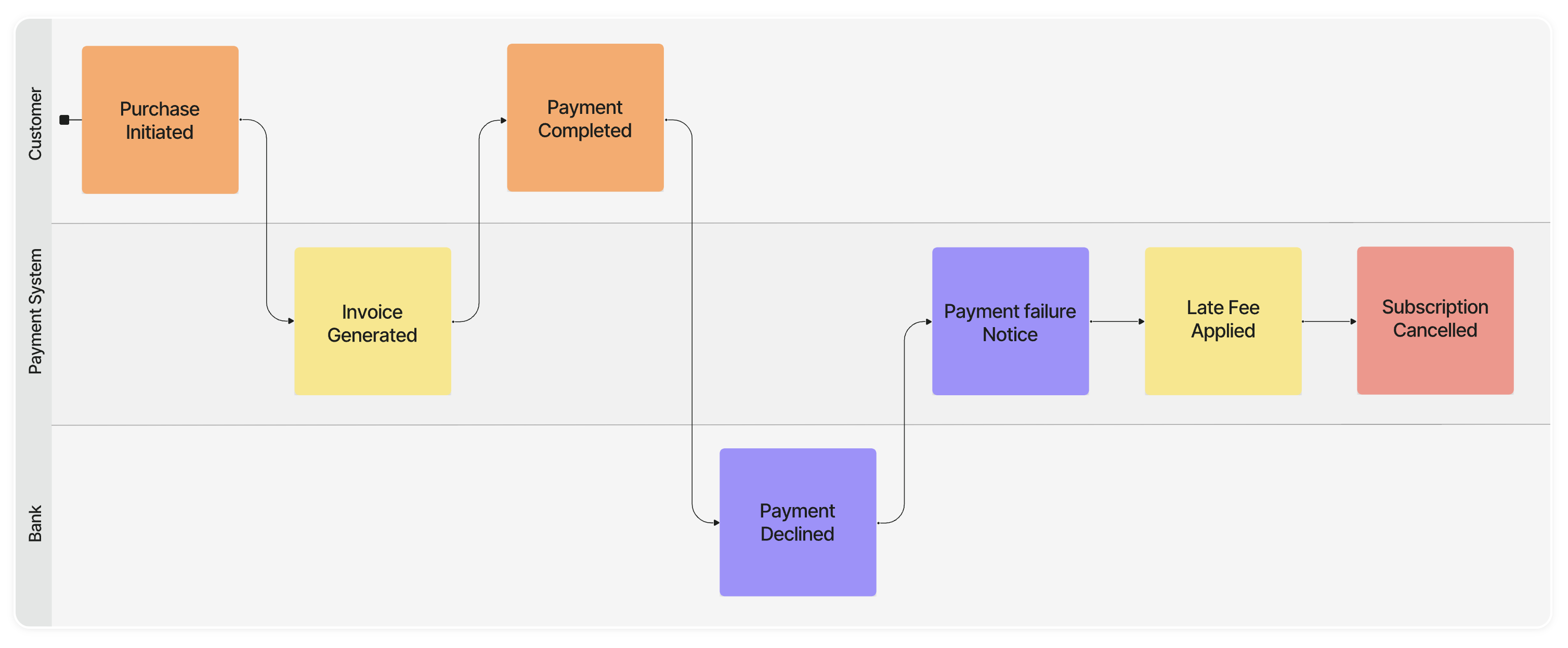
- Model (MDD) – Transform specifications into visual models: processes, event flows, domain models, UI flows, and more. These models act as the structural blueprint.
- Plan – Select architecture, technology stack, integration boundaries, and constraints. Models and specs guide the choices.
- Tasks – Break everything down into precise engineering tasks that align with the specification and the models.
- Implement – AI agents or developers generate code guided by both artifacts. Every unit is validated against the original intent and model structure.
The result is a closed loop: specifications → models → tasks → implementation → verification. Nothing is guesswork. Everything maps back to intent and structure.
Benefits of Combining SDD and MDD
Teams building real, production-grade systems get a repeatable way to move fast without losing control:
- Strong maintainability – Every piece of code traces back to both a specification and a model.
- Higher quality – Architecture, domain rules, and integrations are embedded from the start.
- True predictability – No ad-hoc prompts; the system is generated from structured intent.
- Better onboarding – New engineers understand the system from specifications and models, not tribal knowledge.
- Parallel work – Clear separation of specs, models, and tasks accelerates large teams.
- Improved governance – Auditable specifications and versioned models create transparency.
- Enhanced AI productivity – LLMs perform dramatically better when guided by structured intent and formal models.
- Less rework – Misalignment is caught in the modeling phase, not weeks into coding.
This is not just faster prototyping—it’s a disciplined way to build production systems with AI while retaining control over architecture and behavior.
Qlerify: A Unified Platform for SDD + MDD
Qlerify brings SDD and MDD together in one environment. Instead of switching tools or trying to glue processes together, teams work with connected specifications, visual models, and AI-powered generation flows. Qlerify is built for innovators who want speed and engineering discipline.
Key Capabilities
- AI-Assisted Specification Authoring – Capture rules, events, processes, and requirements through natural language or guided workshops.
- Visual Modeling & Event Mapping – Generate domain models, process flows, user journeys from specifications.
- Automated Decomposition – Convert specifications and models into structured engineering tasks.
- Model–Spec-Code Synchronization – Keep specifications, diagrams and code aligned as the system evolves.
- AI-Driven Generation – Turn the combined SDD + MDD artifacts into working software. Qlerify validates the domain model and pushes it to GitHub as a structured specification, and your AI coding agent reads the model over MCP to generate frontend, backend and unit-test code on your chosen tech stack. The agent can also generate an OpenAPI specification for the APIs directly from the model.
- Collaboration and Version Control – Real-time co-editing and full revision history for both models and specifications.
- MCP Server Support – Connect the AI coding tools you already use, such as Claude Code, Cursor or Antigravity, directly to Qlerify through its MCP server for fully integrated, spec-driven workflows. The in-app MCP Setup dialog gives you copy-paste configuration for each client.
Qlerify gives innovators a cohesive way to build ambitious systems with AI—without sacrificing structure or clarity.
Start Building with SDD + MDD
Start a free trial (4 weeks, no credit card required) or book a live demo to see how Qlerify helps you build advanced systems quickly, cleanly, and with a level of control that pure prompt-driven coding can’t match.